BY MICKEY BAINES
Human Capital Education’s 2026-2027 Admitted Student Review (ASR) gathered responses from more than 70,000 admitted students across 91 institutions. Between them, those students named 2,083 different colleges and submitted more than 420,000 applications.
Since the report was published, we have been reviewing the admitted student data with our partners at two levels: the national results for context, and each institution’s own data to see what its admitted students are telling it. Five findings keep coming up with the enrollment leaders we work with, and each one informs the enrollment growth strategy for the 2027 class.
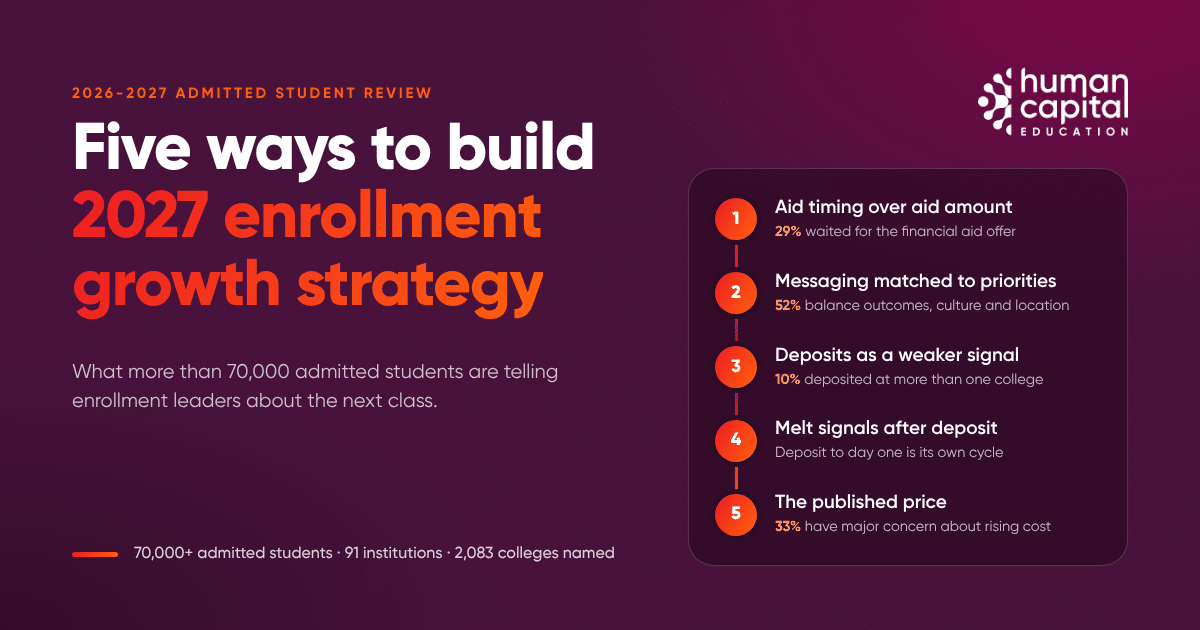
1. Financial Aid timing is deciding more of the class than aid amount
Our financial aid optimization work already models how different students respond to aid rather than treating it as a single dial. The admitted student survey tells us which students are waiting to receive their financial aid offer. Interestingly, comparing the data across the 90+ participating institutions reveals that the students waiting on the financial aid offer varies by school. An optimized financial aid optimization strategy tests award timing and structure alongside amount, and sets up in-cycle monitoring so mid-cycle enrollment adjustments happen while the class is still forming.
2. Tailor marketing messaging to the factors that matter most
So an institution leading with career outcomes is speaking directly to roughly a quarter of its admitted students. Our marketing services team builds persona-driven messaging at the program level for this reason, and the report shows how those personas actually distribute.
The later decision window also creates a capacity problem: 15% of admitted students waited as close to the notification deadline as possible, up from 11% last year, so teams end up recruiting the next class while still landing the current one. Our enrollment services coaches add capacity during that overlap.
3. Deposit counts are becoming a weaker planning input
Deposit-to-enrollment ratios will keep losing predictive power as the number of students double depositing climbs. Our team collaborates with partners on enrollment optimization and analytics to build yield forecasting by segment and across the cycle, allowing institutions to look across multiple factors to build more accurate forecasting models.
4. The signals exist to identify and target students at risk of melting after deposit
A higher education CRM and technology audit surfaces data silos and identifies opportunities to build the plumbing will support unified dashboards. Use the audit to answer whether the obstacle is the platform, the integrations, or the processes around them, and what to fix first.
5. The published price is doing work the discount cannot undo
At the same time, two measures went the other way: major concern about the rising cost of attendance rose four points, to 33% of respondents, and major concern about needing paid employment while enrolled rose one point, to 19%.
In our tuition and fee pricing strategy conversations with partner institutions, we emphasize that routine increases of 2% or 3% have the effect of moving the published price away from the value students see. Fee simplification is becoming a recurring, and increasingly important, topic of conversation. A family that cannot explain what it owes is a family that worries about what comes next.
Building your 2027 enrollment growth strategy
The national results show where to look, and your own admitted pool, including the students who chose somewhere else or chose not to enroll at all, shows what to change first. Our strategic enrollment consulting work with partners planning the 2027 class starts with that comparison.
Download the 2026-2027 Admitted Student Review for the full findings, the four decision segments, and the recommendations behind each of them.
Join the 2027-2028 Admitted Student Survey to see your own admitted students against the national benchmark. The survey opens in spring 2027.
Frequently Asked Questions
What should a 2027 enrollment growth strategy include?
How should colleges adjust financial aid timing to improve yield?
Treat award timing as a variable alongside award amount. In the 2026 cycle, 29% of admitted students waited for the financial aid offer before deciding, including 36% of first-generation students. A competitive award that arrives after a competitor’s can still lose the student, so financial aid optimization should identify which of your admitted students wait on aid and test when their offers go out.
How do you forecast yield when double deposits are rising?
Forecast yield by segment and across the cycle, using enrollment analytics that do not rely on deposit counts alone. Ten percent of admitted students deposited at more than one college in 2026, double the 2024 rate. Certainty did not predict double depositing, but market position did: 21.8% at Tier 2 of the Profile-Demand-Index, compared with 4.7% at the top tier.
What should enrollment teams track between deposit and the first day of class?
Track visit frequency, email engagement, portal activity, and onboarding step completion together, in real time. The Admitted Student Review recommends treating the deposit-to-day-one stretch as its own recruitment cycle, with every office that touches a deposited student on the same communication calendar. If your CRM and student information system cannot show those signals in one place, a higher education CRM audit identifies what to fix first.
How can a college compare its admitted students to the national benchmark?
Participate in the Admitted Student Review. Participating institutions receive their own results alongside the national benchmark, including responses from admitted students who enrolled elsewhere or did not enroll anywhere. Comparing the two shows which national patterns appear in your own pool and which do not. The 2027-2028 admitted student survey opens in spring 2027.
About the author