Who We Are

The Story Behind the Numbers: Reflections from NACAC 2026
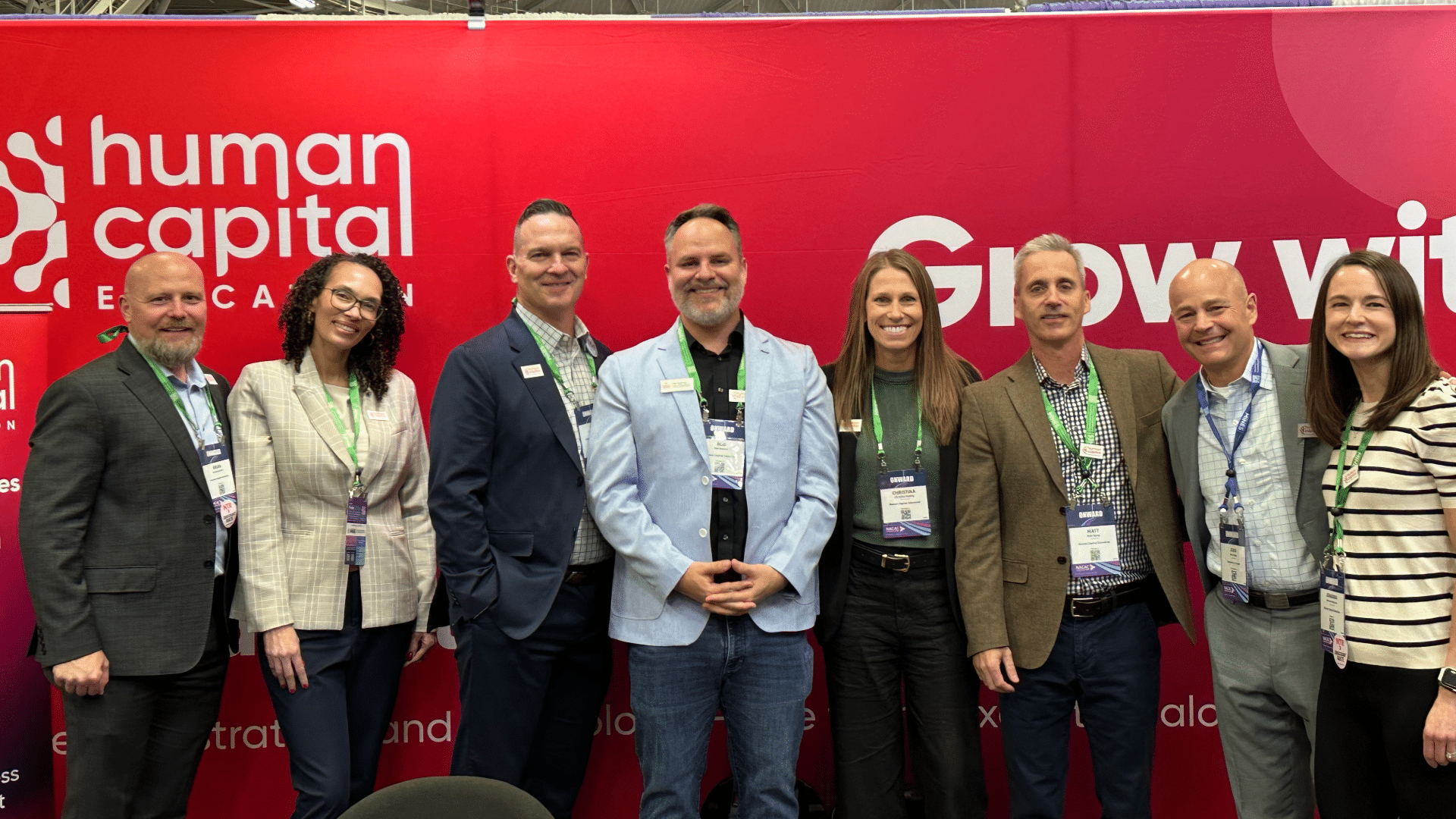
Team from Human Capital Education standing in front of the Human Capital booth at NACAC 2026

October 16, 2026

One of the unexpected hits at this year’s NACAC conference in Minneapolis was a collection of stickers we brought along to the Human Capital Education booth.
It was a little enrollment management inside baseball, and judging by the response, it landed. We hope these stickers find their way onto the water bottles and/or laptops (as well as into board meetings) of our enrollment colleagues to serve as subtle reminders about what really matters.

Applications, deposits, yield, melt, retention, discount rates, net tuition revenue … we measure them, model them, worry about them, and (for quite a few of us) lose sleep over them.

And rightly so.
Behind those numbers are the financial realities that determine whether colleges and universities can sustain their programs, support their people, invest in their futures, and ultimately fulfill their educational missions for students.

The numbers may tell us how we’re performing, but they don’t necessarily explain why.

That distinction was on our minds as we talked with colleagues from institutions across the country, occupying vastly different positions in the enrollment market. Their challenges were as varied as the institutions themselves.
In our work, we’ve repeatedly encountered situations where the presenting problem isn’t necessarily the underlying problem. A technology challenge may reveal fragmented decision-making or organizational structures. A marketing problem may expose uncertainty about institutional identity or market position. And sometimes capable enrollment professionals understand exactly what needs to change but lack the ability or institutional support to change or influence it.
To better understand what’s happening beneath the surface, we often as our enrollment and admissions partners three questions.
  1. What are we promising students, and how well does that promise resonate with those we’re trying to reach?
    These questions explore institutional identity, market position, communication strategy, educational relevance, perceived value, and affordability. They ask whether what an institution believes makes it compelling aligns with what prospective students value—and are willing to pay for.
  2. How well are we organized, equipped, and empowered to deliver on that promise?
    Beyond budgets, staffing, and technology, this question examines leadership, culture, collaboration, accountability, and whether the institution’s resources and priorities support its commitments sustainably.
  3. To what extent does the experience students actually have at our institution fulfill the promise we’ve made?
    Students’ encounters with financial aid, academic programs, advising, student services, and countless everyday interactions determine whether the promise becomes a frictionless reality—and may point to why students stay or leave.
Of course, these questions deeply intersect, and the relationships among them are recursive: What students experience today shapes institutional reputation and future demand. Financial results influence the resources available to fulfill tomorrow’s promises. And institutional leadership determines how effectively the entire system responds.
That’s why the connections and gaps within promise, capacity, and delivery may be more revealing than any individual enrollment metric.
The next time an enrollment challenge presents itself, perhaps we should resist the temptation to jump immediately to a solution.
Instead, begin with those three questions.
And then ask one more:

Which of these three questions is the hardest for your institution to answer right now?

The answer—or the difficulty of answering—may be precisely where the work needs to begin.
Ready to learn how Human Capital Education helps colleges and universities develop winning admissions and enrollment growth strategies? Let’s have a conversation.
Photo of Ken Anselment

By Ken Anselment

Sr Director, Strategy and Operations

Ken Anselment has been a NACAC member since 2001. He has served in a variety of leadership roles for the organization, and is a member of NACAC’s board of trustees. With more than 30 years of experience in higher education, Ken helps institutions make sense of evidence to shape student experience and build organizational best practices. He is an author and the host of The Admissions Leadership Podcast.

John Haller, Human Capital Education

By John Haller

Principal, Strategy and Operations
John Haller has been affiliated with NACAC since he began working in Admission in 1995. He has represented NACAC serving Saint Joseph’s University, the University of Miami, and Denison University. He is currently serves on the NACAC Admission Practices Committee. Last year, he attended and represented NACAC as part of their Member Day of Advocacy on Capitol Hill.